
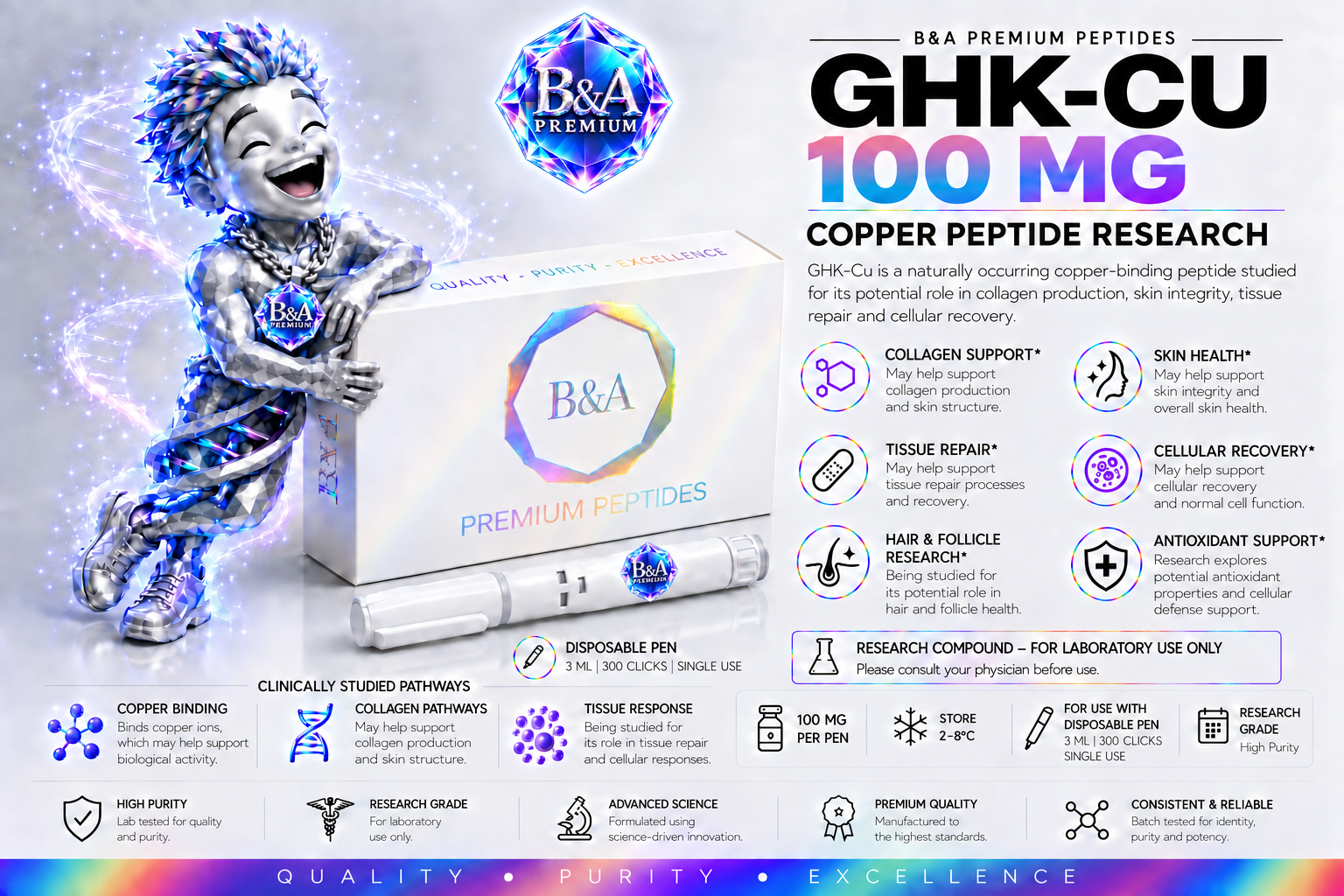
Description
GHK-Cu is the copper(II) complex of the naturally occurring tripeptide glycyl-L-histidyl-L-lysine. Its small copper-binding structure is widely investigated in cellular and extracellular-matrix research.
Potential Benefits — Research Is Ongoing
Potential benefits are based mainly on cell, animal and topical skin research; these results have not been confirmed for this injectable research presentation.
- Collagen support: May encourage the production and renewal of collagen.
- Connective-tissue repair: May support the rebuilding of tissue after damage.
- Skin-matrix renewal: May support renewal of the structural material surrounding skin cells.
- Wound-repair processes: May encourage repair-cell activity and tissue remodelling.
- Skin-cell recovery: May support the recovery of stressed or damaged skin cells.
Research sources: Collagen-synthesis study; Connective-tissue wound study; Skin-matrix synthesis study.
Research Overview
GHK-Cu is studied for how copper-binding peptides influence the connective-tissue matrix. Much of the evidence comes from cultured cells and animal wound models, where researchers can measure collagen production and tissue organisation directly. These findings provide research context rather than proof of a cosmetic or therapeutic result from this pen.
Mechanism / Pathway
The Gly–His–Lys peptide coordinates copper ions. Researchers examine how this complex affects fibroblast activity and extracellular-matrix production, the network of proteins and other molecules that supports tissues. Activity depends on the experimental model, concentration and delivery conditions.
Important Research Information
Cell and animal findings do not establish the safety or effectiveness of this 3 mL research presentation for human use. Topical cosmetic findings also cannot be transferred to a different route or formulation. The 50 mg and 100 mg listings indicate total research content; a larger amount is not evidence of a greater benefit.
Published Research
- [1] Maquart et al. (1988): GHK-Cu and collagen synthesis in fibroblast cultures.
- [2] Maquart et al. (1993): Connective-tissue accumulation in rat experimental wounds.
Scientific Profile
Research Areas
Published research examines GHK-Cu as a copper carrier and signalling complex.
- Copper transport and cellular signalling
- Collagen and extracellular-matrix models
- Skin and hair follicle biology
- Cell migration and tissue-remodelling pathways
- Oxidative-stress and inflammatory-response models
Product Presentation
- Format: 3 mL prefilled disposable research pen
- Pen graduation: 300 clicks
- Research compound: GHK-Cu, 100 mg total research content
- Storage: Keep refrigerated at 2–8°C and protect from light
Research-Use Notice
GHK-Cu 100 mg presentation options
The 100 mg figure on this prefilled pen refers to total labelled content. The GHK-Cu 100 mg Vial is listed separately; matching amounts do not establish identical concentration or handling requirements.
For identification and supporting information, open the GHK-Cu 100 mg product guide.
Compare the GHK-Cu 50 mg prefilled pen for the other labelled strength in this format. Check each listing’s total labelled contents and product-specific information before selecting.
Warnings, Contraindications & Safety Information
Research use only. This is an evidence-limited safety summary, not a package insert, complete prescribing information or permission for self-administration. References to licensed medicines describe those specific products; they do not establish B&A product approval, equivalence or safety.
Contraindications & Who Should Avoid Exposure
A clinically validated contraindication list for this exact research presentation has not been established. That absence is not evidence of safety. Do not expose a person with a known allergy to a labelled ingredient or excipient.
Warnings & Precautions
This research presentation has not been established as safe for human administration. Do not use during pregnancy or breastfeeding, or in children. A serious medical condition, including cancer or significant liver or kidney disease, requires professional assessment; this page cannot establish suitability.
Possible Adverse Reactions
Reliable frequencies and a complete human adverse-reaction profile for this exact product are unavailable. Allergy, local irritation and contamination-related harm remain possible; absence of reports does not establish absence of risk.
Drug & Supplement Interactions
Drug and supplement interactions have not been adequately characterised for this presentation. Do not assume that combining it with prescription medicines, hormones or other research compounds is safe. Give a clinician the full ingredient list if exposure has occurred.
When to Seek Urgent Help
Seek emergency care for difficulty breathing, swelling of the face or throat, collapse, severe persistent abdominal pain, or repeated vomiting with inability to keep fluids down. Stop further exposure and show the clinician the product label and ingredient list.
Handling & Storage Cautions
Follow the actual product label and batch-specific expiry information. Do not use damaged, contaminated or unexpectedly changed material. A clear appearance, refrigeration or addition of bacteriostatic water does not prove sterility, compatibility or a safe shelf life. Do not share needles, pens or opened material between people.
Safety references: FDA research-peptide and compounding safety context. Information reviewed 20 October 2026.
Reviews
There are no reviews yet.